;}.cls-2{fill:url(%23Unbenannter_Verlauf_5-2);}.cls-3{fill:url(%23Unbenannter_Verlauf_5-5);}.cls-4{fill:url(%23Unbenannter_Verlauf_5-6);}.cls-5{fill:url(%23Unbenannter_Verlauf_5-3);}.cls-6{fill:url(%23Unbenannter_Verlauf_5-4);}%3c/style%3e%3clinearGradient%20id='Unbenannter_Verlauf_5'%20x1='1075.02'%20y1='943.06'%20x2='1201.78'%20y2='943.06'%20gradientUnits='userSpaceOnUse'%3e%3cstop%20offset='0'%20stop-color='%2322b88a'/%3e%3cstop%20offset='1'%20stop-color='%231a9e78'/%3e%3c/linearGradient%3e%3clinearGradient%20id='Unbenannter_Verlauf_5-2'%20x1='234.11'%20y1='663.43'%20x2='1058.29'%20y2='663.43'%20xlink:href='%23Unbenannter_Verlauf_5'/%3e%3clinearGradient%20id='Unbenannter_Verlauf_5-3'%20x1='843.79'%20y1='1064.84'%20x2='1096.04'%20y2='1064.84'%20xlink:href='%23Unbenannter_Verlauf_5'/%3e%3clinearGradient%20id='Unbenannter_Verlauf_5-4'%20x1='1120.37'%20y1='662.1'%20x2='1253'%20y2='662.1'%20xlink:href='%23Unbenannter_Verlauf_5'/%3e%3clinearGradient%20id='Unbenannter_Verlauf_5-5'%20x1='97.45'%20y1='265.53'%20x2='385.89'%20y2='265.53'%20xlink:href='%23Unbenannter_Verlauf_5'/%3e%3clinearGradient%20id='Unbenannter_Verlauf_5-6'%20x1='295.45'%20y1='255.64'%20x2='1213.95'%20y2='255.64'%20xlink:href='%23Unbenannter_Verlauf_5'/%3e%3c/defs%3e%3cpath%20class='cls-1'%20d='M1201.78,871c-.61,1.55-1.23,3.1-1.86,4.66-20.33,50.18-47.14,96.85-80.02,139.45-7.56-13.82-21.78-22.31-37.69-22.31h-7.19c29.82-37.26,54.46-78.02,73.61-121.8h53.15Z'/%3e%3cpath%20class='cls-2'%20d='M665.24,264.59l69.02,186.52c21.3,57.57,66.69,102.96,124.26,124.26l186.52,69.02c17.67,6.54,17.67,31.54,0,38.08l-186.52,69.02c-57.57,21.3-102.96,66.69-124.26,124.26l-69.02,186.52c-6.54,17.67-31.54,17.67-38.08,0l-69.02-186.52c-21.3-57.57-66.69-102.96-124.26-124.26l-186.52-69.02c-17.67-6.54-17.67-31.54,0-38.08l186.52-69.02c57.57-21.3,102.96-66.69,124.26-124.26l69.02-186.52c6.54-17.67,31.54-17.67,38.08,0Z'/%3e%3cpath%20class='cls-5'%20d='M1082.21,1021.98h-79.13c-1.7,0-2.97-1.56-2.62-3.23l22.72-109.35c2.94-14.16-15.11-22.74-24.23-11.51l-152.04,187.31c-7.32,9.02-.9,22.5,10.72,22.5h79.13c1.7,0,2.97,1.56,2.62,3.23l-22.72,109.35c-2.94,14.16,15.11,22.74,24.23,11.51l152.04-187.31c7.32-9.02.9-22.5-10.72-22.5Z'/%3e%3crect%20class='cls-6'%20x='1120.37'%20y='486.36'%20width='132.63'%20height='351.48'%20rx='19.58'%20ry='19.58'/%3e%3cpath%20class='cls-3'%20d='M250.58,128.27l13.88,55.81c7.19,28.91,29.76,51.47,58.66,58.66l55.81,13.88c9.29,2.31,9.29,15.51,0,17.82l-55.81,13.88c-28.91,7.19-51.47,29.76-58.66,58.66l-13.88,55.81c-2.31,9.29-15.51,9.29-17.82,0l-13.88-55.81c-7.19-28.91-29.76-51.47-58.66-58.66l-55.81-13.88c-9.29-2.31-9.29-15.51,0-17.82l55.81-13.88c28.91-7.19,51.47-29.76,58.66-58.66l13.88-55.81c2.31-9.29,15.51-9.29,17.82,0Z'/%3e%3cpath%20class='cls-4'%20d='M1213.95,453.21h-67.62c-1.23,0-2.47.04-3.67.12-27.03-63.89-65.84-121.36-115.42-170.94-51.54-51.54-111.61-91.44-178.55-118.59-64.67-26.22-133.03-39.52-203.16-39.52s-138.48,13.3-203.16,39.52c-33.73,13.67-65.72,30.61-95.75,50.63l-.19-.05c-23.62-5.88-42.51-22.85-51-45.24,37.87-26.86,78.65-49.21,122.01-66.79,72.63-29.44,149.37-44.38,228.08-44.38s155.45,14.93,228.08,44.38c75.2,30.51,142.67,75.31,200.53,133.15,57.84,57.85,102.65,125.33,133.15,200.53,2.31,5.7,4.54,11.43,6.66,17.19Z'/%3e%3c/svg%3e)
7 signs your IT support is overwhelmed
Rising ticket times, systematic overtime, shadow IT: the 7 clearest warning signs and how to course-correct.

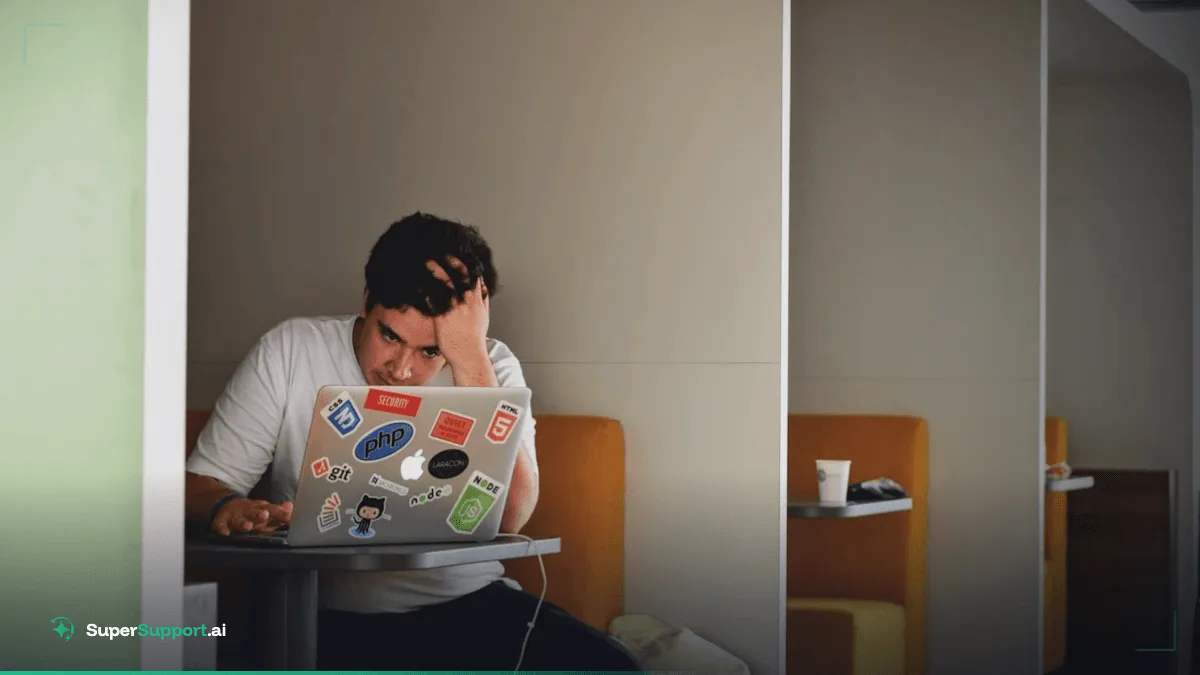
The symptoms nobody talks about
There's a pattern in IT departments that creeps in slowly. Not as a crisis, but as a gradual normalization. Ticket times get longer. Satisfaction drops. The team works overtime. But nobody says: "We're overwhelmed." Because that's seen as weakness.
But being overwhelmed isn't team failure. It's system failure. And the system can be changed.
Here are the seven clearest signs that your IT support is at capacity and what you can do about it.

Sign #1: Average resolution time is steadily rising
If your Mean Time to Resolution (MTTR) was 2 hours a year ago and now it's 6 hours, that's no coincidence. It's a clear signal: Ticket volume is growing faster than capacity.
The treacherous thing: A rising MTTR is often invisible because it changes slowly. Nobody notices the increase from 2 to 2.5 hours. But when you look after 12 months, the number has tripled.
Sign #2: Level 1 escalates too much
If your Level 1 team forwards 40-50% of tickets to Level 2, it's no longer solving, it's just sorting. This can have two causes:
- Problems are getting more complex (e.g., new software, cloud migration)
- The team doesn't have time for thorough diagnosis and escalates preemptively
Both point to overload. A well-functioning Level 1 team resolves 60-70% of tickets on its own.
Sign #3: Employees bypass official support
When employees start sending their IT problems via Slack DMs to the "tech buddy" in their department instead of writing a ticket, that's a strong signal. It means: The official channel is so slow or cumbersome that people actively avoid it.
Shadow IT support is a warning sign, not a compliment to the helpful colleague.

Beta
IT support that fixes itself.
supersupport.ai handles your 1st-level support fully automatically. Secure your spot on the waitlist now.
Join the WaitlistSign #4: The team systematically works overtime
Overtime once a quarter because of a major incident? Normal. 2-3 extra hours every week to work through the ticket queue? That's chronic overload.
The consequences: Burnout, turnover, declining quality. And the cynical irony: When someone quits, the burden on the rest gets even higher.
Sign #5: Recurring problems aren't sustainably resolved
When the same printer problem appears for 10 employees every week and is solved individually each time, there's no time for root cause analysis. The team is in firefighting mode: putting out fires instead of preventing them.
Proactive IT, solving problems before they occur, is the first luxury that overloaded teams lose.
Sign #6: Onboarding takes longer and longer
When new employees wait 3-5 days for their complete IT setup, it's rarely due to lack of will. It's because onboarding tasks fall behind "burning" tickets in priority. And there are burning tickets every day.
Sign #7: The satisfaction survey keeps getting worse
If IT support measures satisfaction once a year (or not at all), the feedback signal is missing. But when it is measured and numbers are falling, that's the clearest sign of all.
Employees accept slow support for a while. But at some point, sentiment tips and then IT becomes the enemy.
What you can do: The way out of overload
The solution isn't "hire more people." That's expensive, slow, and doesn't scale. The solution is: Automate the repetitive 70% so your team can focus on the demanding 30%.
- Automate password resets: -30% ticket volume overnight
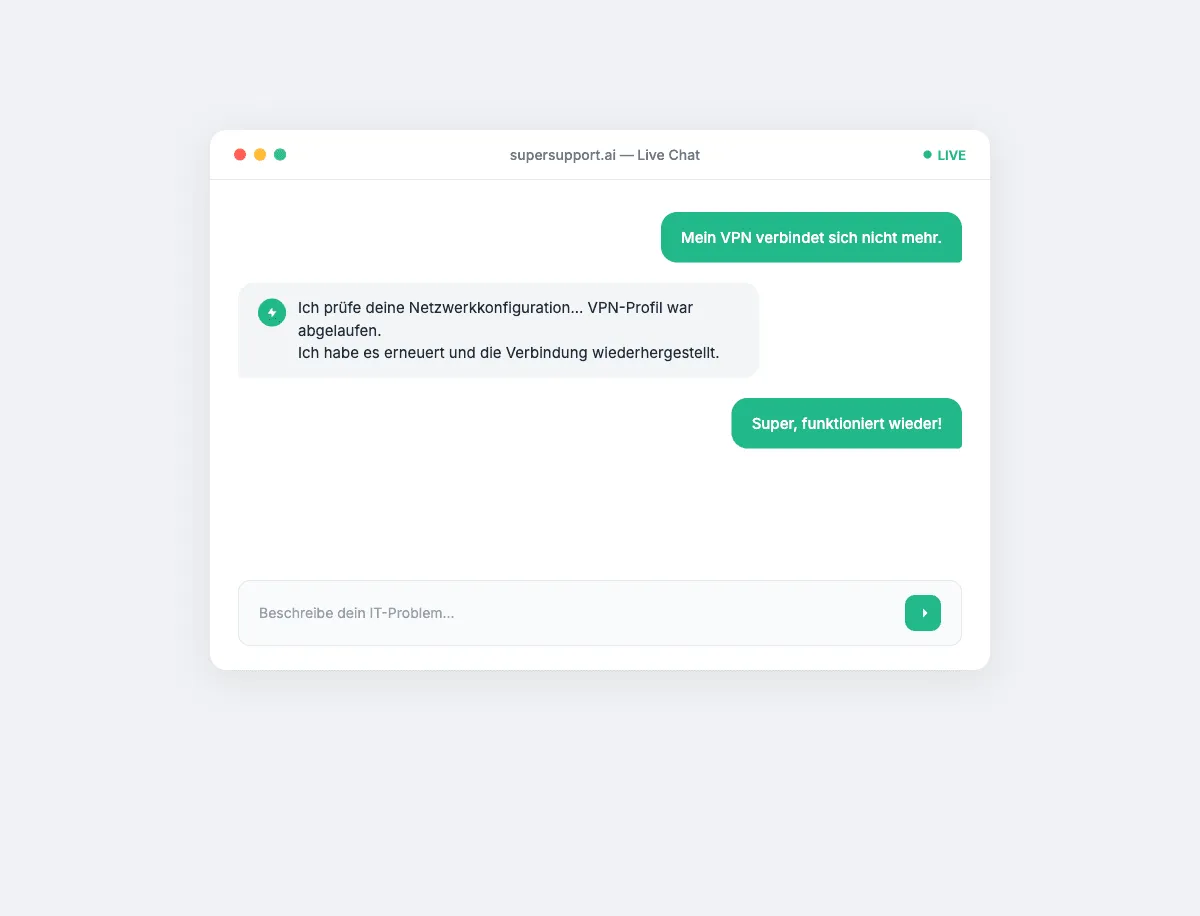
- Automate standard diagnostics: Printer, VPN, email, the most common 5 ticket types
- Automate onboarding: Hours → minutes
- Introduce proactive monitoring: Solve problems before they're reported
SuperSupport.ai is built for this. Sign up for the beta and give your team the relief it deserves.
Beta
IT support that fixes itself.
supersupport.ai handles your 1st-level support fully automatically. Secure your spot on the waitlist now.
Join the WaitlistNico Haslberger ist Co-Founder & CEO von SuperSupport.ai. Mit langjähriger Erfahrung als IT-Techniker kennt er die Probleme im IT-Support aus erster Hand: von überlasteten Helpdesks bis zu wiederkehrenden Tickets, die Teams ausbremsen. Dieses Wissen steckt heute in jedem Feature der Plattform. Er sorgt dafür, dass SuperSupport.ai genau die Probleme löst, die er selbst jahrelang erlebt hat.
Related Articles

5 IT tickets that can be resolved in 60 seconds
Over 60% of all IT tickets follow five patterns, and each can be automatically resolved in under a minute. Which ones and how it works.

Welcome to the Future of IT Support
Our launch video is here. Watch how SuperSupport.ai resolves IT issues in under 60 seconds: autonomously, directly on the device, no helpdesk ticket needed.

Why we founded SuperSupport.ai
Two brothers, one MSP, thousands of identical IT tickets. The story of how the daily grind of a Managed Service Provider became an AI platform that resolves IT support in under 60 seconds, directly on the device.